.
.
.
The creatures are incredibly calm
on this green, green, fresh-rained-upon morning.
Outside my window a rabbit itches
through his morning routine. Preens
his fur, licks his coat
with a cat’s dedication, slides a paw
over his long ear again and again.
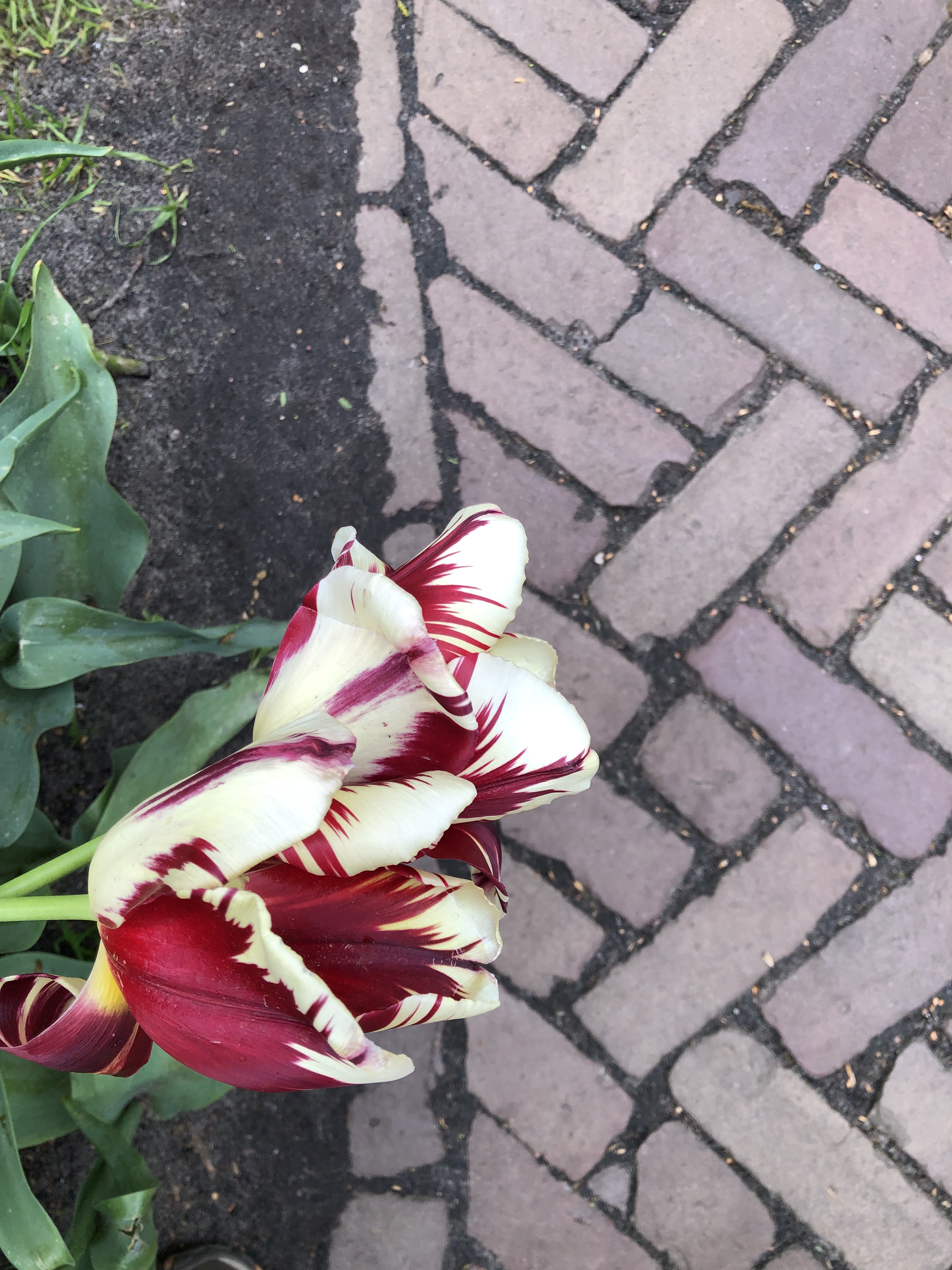
I watch over the red-yellow tips of tulips
vased beside me. I research the Liberation of Holland
75 years ago, today.
These days in Holland they dump millions of tulips to destruction.
The globe is battling a pandemic and they have no time for
smooth-shaped, up-facing cups of posed prettiness.
An estimated 400 million flowers already crushed
(140 million tulips) – and yet
it was such a good year for them – says the director
of a one hundred and ten year-old family farm
which lived through the world wars to come to this.
“It’s very painful” he says.
In World War II a ditsy Canadian soldier crossed enemy lines
unarmed on Christmas day and the Germans mobbed him
with snowballs, they called greetings to each other.
He always was unconventional, his buddies said.
He died being unconventional, walking to where snipers hid
to drop hand grenades on them — whiles his buddies
marched a suicide route across a narrow bridge.
Unconventional too, the way my grandparents
live.
The rabbit lazily hops a few paces
and settles again as if the wet blades of grass
will penetrate his speckled fur with cleanliness.
Grandma said they used to lay white laundry on the lawn
for the sun to bleach it into cleanliness – recalls with laughter
a concerned Canadian neighbour trying to explain with gestures
the concept of a clotheslines – there are so many comedies
in immigration.
The stories we tell are bleached too.
They are white and breezy from the years of sunny
telling. There was a war. Holland was occupied five years.
Yes, it was hard. Men and women acted with bravery.
We were freed. The Canadian soldiers tell a little more:
shock at the starvation they found, people left
only with tulip bulbs to eat.
At the onset of the war didn’t the countries wonder
whether it was all a hoax? Did people ever question
if life could truly go back to normal (answer, no)?
What all was lost in the war
besides lives? What about the ones who were not brave?
The Summer the war ended
100,000 tulips arrived in Ottawa,
gratitude for Canada’s welcoming of the royal family.
The exchange was not only in thanks and tulips.
The Canadian government wanted to patch the holes
torn in farm societies with so many young men lost
at war. Canada liberated Holland and Holland came to settle them,
largest immigrant minority at the time. They came and built
everything – schools, businesses, farms,
churches, homes, families, and all across
the wide span of the world’s second largest nation they built
flower shops.
Still 20,000 tulips cross the ocean every year,
gifted from the lowlands
to the North. There are riddles here
and we need our grandparents’ stories now more than ever.
We need to know that even if life is irrevocably changed
for our generation there are more generations to come.
There is a reason to push forward, push back the ocean,
drain the swamps, build the structures, learn new trades,
learn new languages, joke about it all. Tulips
are destroyed today but they will grow again.
Until then, one pert bundle sits on my desk
as I look back to ask questions
of the past.
.
.
.
Today is Liberation Day! Holland celebrates their liberation by the Canadian army at the end of World War II. As I research more this year and listen to the stories that have always been in the background of our lives (as Dutch-Canadians), I can’t help hearing in my other ear the many world leaders comparing this pandemic to a war. And I wonder — what can we learn from our grandparents’ generation? The answer to that would take many pages. Today, I am grateful for the story I inherit — even as it gets messy and complicated the more you dive into it.
Since the bulk of poetry is revision, daily posting is a strange (interesting?) experience. Longer poems, like this one, end up being more of a thought journey than a finished piece when there is no time to revise.


Leave a comment