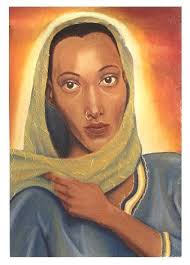
“Hagar, Sarai’s maid, Where have you come from and where are you going?”
Never in my life have I heard such a voice. I stop. Uncertain. Who is this who calls me by name?
I am Hagar. I am a daughter of Misrayim.
This man, he must know about the people of Misrayim. Long ago, the God who made the world saw that children of men had hearts that were crooked.
God sent a great water. Only the man Noah was saved with his family. His three sons: Shem, Ham, and Japheth, and their wives. God blessed Noah and his three sons, saying, “Be fruitful and multiply and fill the earth.” and God spoke then a new word, a new thing into this world, called covenant. God made a bow of bright colours in the sky to mark this covenant.
Does he know this story?
Ham had these sons: Cush, Mizraim, Put and Canaan. 340 years after the flood, just before Noah died, all people came together to build a tower to heaven. Instead, God brought confusion. People began speaking other tongues. Families separated, moved apart, began spreading. That was not so long ago, only 400 years.
I am a daughter of Mizraim. Misrayim is what others call our kingdom. But we call our own land
“twy” meaning two lands, and “kemi” meaning black land.
You are looking around you now, yes? We stand at this well, and all around you see dry wilderness. Kemi, it is a beautiful land. We are truly blessed. Even Abram’s nephew Lot has said my land, it is like the garden of God. There is no dry dust or thirst there.
Who am I?
I am Hagar.
Ten years ago Abram the wanderer came to my country. He is from the family of Shem. He tells a strange story. God, it seems, has chosen his family to bring the promised child into. But when he arrived in our land Abram’s wife, Sarai, was barren. She still is.
They came because of the severe famine in Canaan’s land. They came to my beautiful land, Kemi. And my life was never the same.
Sarai was very beautiful. We could all see it. Someone spoke of her to our ruler, to Pharaoh. He took her into his house, since she said she was Abram’s sister. He treated her brother well for her sake. Abram received gifts of sheep and oxen and donkeys. Our king gave him all this, and male and female servants besides. And camels. And me. Who am I? Hagar, one of the many servant girls in Abram’s household.
I was curious. This man who had wandered so far from his homeland, this son of Shem. What could he want?
He wanted, it turned out, to live. Famine had chased him to our land, and fear had put a lie in his mouth. Sarai was not his sister. She was his wife.
What a terrible time! Sicknesses and diseases and plagues in the house of Pharaoh! Our people suffered. It was the hand of a god, heavy on us all! Abram’s god, angry that Sarai had been taken.
Pharaoh called Abram, saying, “What is this you have done to me? Why did you not tell me that she was your wife? Why did you say, ‘she is my sister,’ so that I took her for my wife? Now then, here is your wife, take her, and go.”
Pharaoh’s men escorted Abram’s household, Sarai and all of us his servants and his wealth, to the borders of Misrayim. From there we journeyed through the Negev.
That is how I left my land: hustled out. Because of a lie, gifted to this man Abram in exchange for his sister-wife. Abram, a man with a promise. Abram, with a barren wife. Abram, a man of fear. Abram, with a God who acts for him. Abram, always going, never arriving.
Since that day, we have been traveling for ten years. Ten years!
I watch this man and his wife closely. I listen to all the servants say about them. This wasn’t just any god who intervened for Abram; it was the God who created the whole world. Could it be? This God, he was angry, because he had given Abram a promise to bless the whole world through a child of his, and Abram had given away his wife to save his own life (the servants told me he lied about Sarai being his wife so that we would not take her from him by force and kill him, because of her beauty).
It all seemed so strange to me. A God this powerful? And yet Abram is wandering through lands that don’t belong to him, because of a promise that they will belong to his descendants. He is waiting, it seems, for his wife Sarai to give birth. She never will. She is as barren as this wilderness I stand in now, facing my unknown visitor. How can God accomplish his promise when there is no child?
Yes, that is where I enter the story. That is why I am here, in the wilderness. Far away from my beautiful land.
Because I have the child of promise right here; his heart is beating now, right in my own womb. Sarai knows. Sarai is jealous.
Of course, it is normal for a wife to give her husband her maid if she cannot have children. The maid’s children belong to that wife. God, in all his promises to Abram, never told him it would be by Sarai that he would have the promised child.
Sarai and I had grown very close over the ten years. She is so beautiful, my lady Sarai. She is kind. She trusted me, and I trusted her. It was hard for her to see no one from her family, to always be moving, to watch Abram’s vitality drain away with the long years, and to know that it was her body to blame for the promise being delayed so long. She carried that with her like a weight.
Abram loved her. There was no doubt of it. It is accepted by all our people that a man can divorce a childless wife, in order to remarry. But he would not divorce Sarai. That burned her even as it warmed her.
I was far from my family, too. Far from my country, like Sarai. She could have no child; but neither could I. I had never married, and wasn’t becoming any younger myself.
Ten long years like this. Then she acted. Abram had received another promise from God. Abram asked God how he could fulfill the promise since he was childless? Would God bless Eliezer of Damascus, the appointed heir? God said, “This man will not be your heir; but one who will come forth from your own body, he shall be your heir.” God showed Abram the stars of the sky and the sand of the sea and told him that his descendants would be more in number than either of these. Abram believed this.
Sarai worried over the meaning of this. She spoke to Abram, saying, “Now behold, the LORD has prevented me from bearing children. Please go in to my maid; perhaps I will obtain children through her.”
That is how I came to bear the child of promise. I knew then how much Sarai favoured and trusted me. Abram listened to Sarai. He is a good man, a gentle man. For once, by this couple, I felt seen – and known – not merely a slave any more, but part of the family.
It did not last long.
With the first signs of pregnancy, I rushed to tell Sarai. “Sarai, the promise will come! Sarai, I have conceived.” Her face flushed red hot to hear these words. I was elated. “All of history will remember me as blessed, blessed, blessed. To bear into the world this child that God has spoken so much of, promised so much to! The child of Abram!”
Jealousy burned in Sarai’s face. I didn’t notice. “Just think, I who had no part in the story that will be passed on, no child who could remember me. Just think, now the one child who will bless all nations will call me Mother! All people will know my name. They will hear of Hagar.”
Something broke between me and Sarai that day. If Abram stooped to greet me or ask how I was, she would eye us both with extreme jealousy. When I started resting more frequently, the difficulty of this pregnancy hitting me, she was beyond impatient. And the more I spoke of the coming child being the child of promise, the more I could see the pupils of her eyes narrow and harden with something that looked like – could it be? – hatred.
Sarai went to Abram, saying, “May the wrong done me be upon you. I gave my maid into your arms, but when she saw that she had conceived, I was despised in her sight. May the LORD judge between you and me.”
In my sight? Sarai, condemning me for how I see her – has she ever truly seen me? Does she understand how this pregnancy has lifted my significance in the cosmic story, in the family of Abram, in the future of the world? Before I was nothing. A woman without children has no continuance. Now, I bear the heir of all that Abram owns, and more than that, of all that Abram has been promised.
Yes, Sarai knows this. But does she see me? I thought she did. Now, I know that whatever she saw has been clouded by clouds of anger and hatred.
Abram will protect me, I thought.
But he replied to Sarai, “Behold, your maid is in your power; do to her what is good in your sight.”
What was “good in Sarai’s sight” was to treat me harshly. That is why I am here in the desert, here with the man standing before me, questioning me.
It was too much, I want to say. He asks where I’m going, where I’m from. Do I say I’m from Misrayim, the land I last saw ten long years ago? Do I say I’m from the dusty tents of Abram’s mobile household, the very household that has turned upon me in my moment of greatest weakness as I bear the child of the master himself?
Where am I going? Anywhere. Away from Sarai.
“Hagar, Sarai’s maid,” he intones.
He knows, I think. How does he know?
“Where have you come from and where are you going?”
I clear my throat, eyes searching the dry earth. “I am fleeing from the presence of my mistress Sarai.”
His reply comes, “Return to your mistress, and submit yourself to her authority.”
At this, I lift my eyes to his face in a mute plea for help. Tears fill my eyes. How can I go back? Won’t Sarai who hates me, hate my child? Abram will do nothing. Is there no help? Who is this man?
“Behold, you are with child,
and you will bear a son:
and you shall call his name Ishmael,
because the LORD has seen your affliction.
He will be a wild donkey of a man,
His hand will be against everyone,
and everyone’s hand will be against him;
and he will live to the east of all his brothers.”
One hand to my heart, to still the pounding. The other instinctively touches my belly, as if to assure myself that this is no dream, that the child, Ishmael, is truly there.
This man – this man – he is an angel. An angel of the LORD!
When I look up again, he is gone. But his words remain, as if hanging in the air like fruit on a well-laden tree. “The LORD has seen your affliction,” I whisper to myself.
He has named my son, He has called me by name. And His name? The LORD, the covenant God of Abram, His name is shrouded in mysteries.
“You, God, have seen me,” I breathe it out. Then, shocked, “have I remained alive after seeing him?”
In the story of mankind, from Creation to the great Flood, to the dispersion of languages, to God speaking to Abram, I have never heard of God coming to one weeping, lonely slave girl from Misrayim. The unthinkable has happened. He has seen me; I am seen. I am known. So I do the unthinkable: I name the Creator. El-Roi. “The God who sees”
Because of God’s voice, Abram left his home to wander.
Because of God’s message, I will go back to stay.
He sees me. He sees my unborn child. He sees my affliction. He sees me.
Image by: Angel Fire

 A broken tulip
Leave a reply to lindabyler Cancel reply