
Here is a riddle.
Once, in the ancient days, there was a man who was known as the greatest man in all the East. And there were seven sons, belonging to this man, and the sons had homes and animals to feast on, seven times a year, each on their birthday. And there were three daughters, invited into the homes of their brothers for the feasts.
When a haelstrom of loss hit the greatest of men—who you know by the name of Job—all ten of his children died, mid-feast.
There are things in Scripture that stand, seemingly simple. Look closer and you’ll see that there’s an underground world of connection, like the mycelium buried beneath mushrooms, largely invisible and wholly unnoticed by us.
Job goes through intense suffering. He loses everything, for seemingly no reason. He expresses his grief and sense of betrayal by God. God comes and speaks with him directly. The mysteries of Creation are called upon.
Job repents. He prays for his friends who were disastrous comforters. God’s response is to double Job’s material blessings, and give him once more seven sons and three daughters.
But something is different. Job is different. This time, Job names his three daughters: Jemimah, Keziah, Keren-Happuch. It is said that they were renowned in the land for their beauty. And Job gives them an inheritance along with their brothers.
What happened, in the crucible of suffering, that caused Job to name his daughters and to give them an inheritance?
Why suffering?
Is this the teller’s way of saying that Job has welcomed wisdom? Wisdom, in the later book of Proverbs, is personified as a woman. And at the end of the book, a seemingly real woman is praised as the embodiment of the wisdom contained in that book. I’m not sure if there is meaning in this connection, but I know that the book of Job, bedrock of the wisdom literature, is inviting us to ask.
Lately I was reminded of the Joel passage where God pours out His Spirit on both men and women, young and old. The chapter begins with a great army that will come upon the world, bringing darkness and horror and gloom. “And afterwards, I will pour out My Spirit on all people.” At the end of all things daughters will be given an inheritance alongside their brothers. Paul says that male and female alike are sealed in the Holy Spirit for a coming inheritance that we share with Christ, who suffered and died to break with his blood the dividing walls we erect between genders, nations, economic statuses. Is it then still coming; is our full inheritance waiting at the end of a path of suffering and destruction? The end is, of course, another way to say the beginning.
There may be a connection here, there may not. I have to wonder: is it so hard for a daughter to be named and given a place, that Job-level, apocalyptic destruction must be endured for it to be possible?
Flipped the other way: is the invitation Peter sets for us, to place our own feet in the footprints of a suffering Saviour, an invitation to become a child of Wisdom? Is loss the price that buys for us the intuitive return to the first chapter of our story, where male and female are equally children of God, and where unity in diversity is actually possible?
I first heard the beginning and end of Job brought together by Wilda Gafney. The questions I brought into the space are my own.
Photo credit: Alex Ronsdorf on Unsplash.
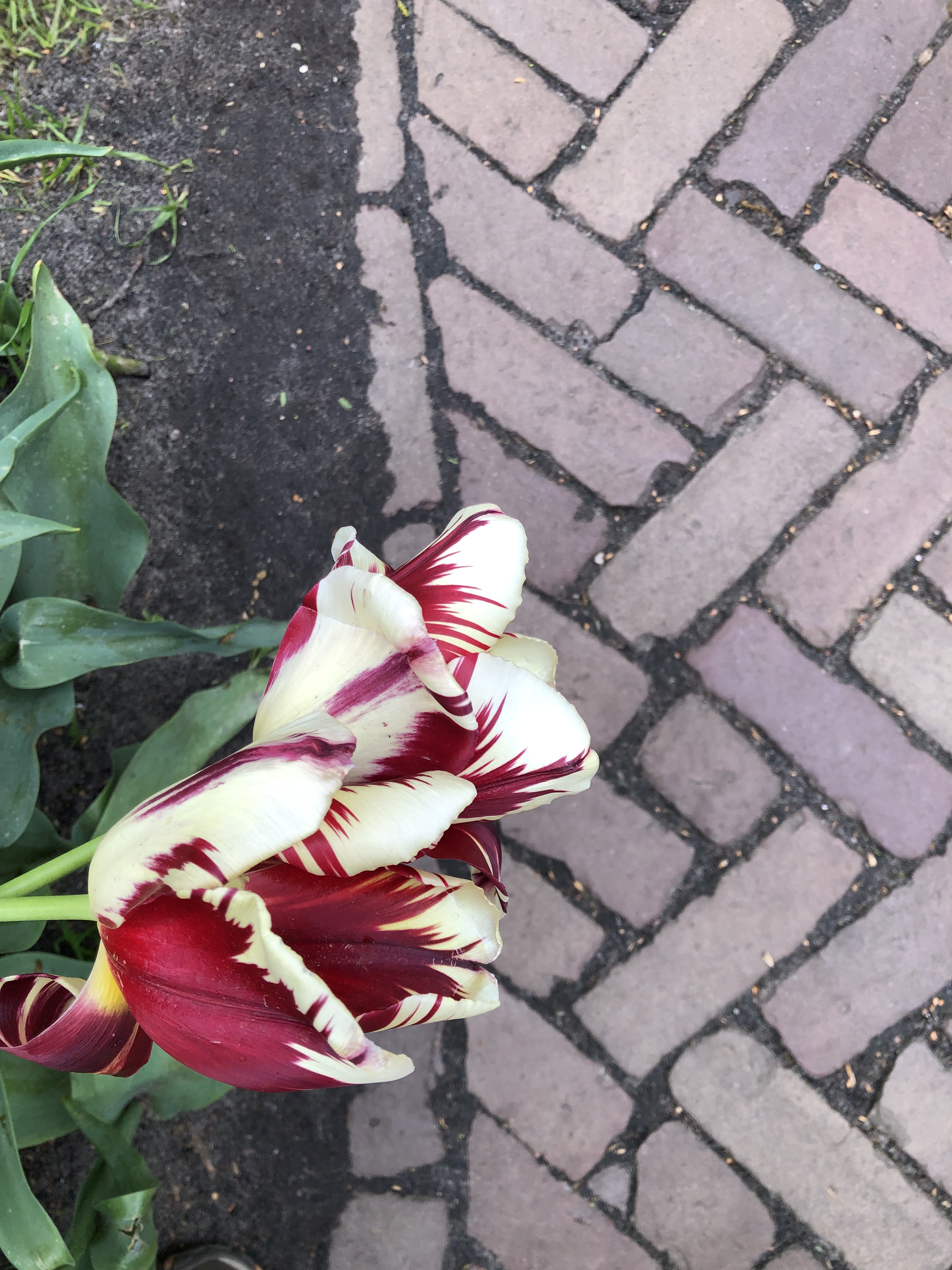
 A broken tulip
Leave a comment