Hello everyone. I hesitated to post anything close to Christmas because the next poem I have is another hard, hard one.
Maybe I was wrong. The first Christmas was dark, dark, dark. The shepherds saw the angel choir and heard peace on earth, but lived the rest of their lives under the oppression and taxation of the Romans. Where was the peace? Mary heard the angel say and he will rule…of his kingdom there will be no end. But what could she point to, after that flash of revelation, as tangible proof of this coming true?
The message of God with us comes to find us where we are. And it doesn’t necessarily change the power structures, the daily realities, that we have been begging God to save us from.
I don’t think that’s because God only came to save our souls, which means, I don’t think God does not care about our reality. I believe that Christ, who holds together all things, will redeem all things—and that very much includes physical realities.
Yet he does not do this through force. He comes to the most unlikely people and invites them to work with him to change—everything. He starts with us and in us and among us.
Faith is so often a paradox, a juxtaposition of realities. There is one reality we live and breathe and it is dark and unfair, twisted and evil. Then the good news comes and it overlays our lives with another reality which counters the darkness with light, bringing justice and mercy, kindness and courage and goodness. Both realities are true, all at once. They are both true in our own hearts. We live into the kingdom of God and pray that it comes and we work for it in real and tangible ways….but it often feels like digging a flower garden and dreaming of dayrise when we are still on the midnight watch.
God does not work the way I wish he did. Recently I meditated on the miracle granted Peter, to see his nets filled with fish. Wanting God to provide for me practically, I wished for the same miracle. But, knowing the rest of the story, I knew that Peter left those nets and fish and wandered into a reality of lack of provision and eventual death following Christ.
I have wished for the gift given Thomas, to be invited to touch Jesus in his resurrected flesh, to see and feel him. But I know that Thomas, who was given sight, was then asked to live the rest of his life in faith of what he could no longer see—Jesus in his newly resurrected body ascended the throne in God’s space, and we do not see him.
God gives us these flashes, these moments, of knowing and seeing and touching. Then we continue along our dark paths, choosing to hold on in faith.
Why?
I’m not sure. I do know that it is important to feast in the darkness and that is what Christmas gives us. God sets our feast table in the midst of our enemies—Psalm 23—but we, like the older brother in the story of the Prodigal Son, can refuse to join him. We can choose instead to work hard towards the future, beggared by our concern for how few resources there are.
God invites us to feast and celebrate and rest in our war-torn, midnight now. Don’t ask me why. I do not know. I just know that the invitation stands—and so we pull out our finest dishes and cook elaborate dinners and invite strangers and friends to come in the door. We trust that, despite all we see, there is enough, there is always enough.
And so, as we talk about men and women and the ways we hurt each other, if you feel trapped and scared right now, if you feel cowed and silenced, or upset and filled with regret, if you feel despair or fear or cowardice or shame—
now is the time to feast.
Maybe you have recently been gifted one of those brilliant moments of seeing the face of God. Rejoice in that light.
Maybe that light came a long time ago for you and you can barely find it in the dim corners of your memory. Maybe it hasn’t come yet.
Rejoice that, seen or unseen, there is a light that casts out darkness.
Jesus celebrated Passover the night he was arrested. Think about it. He celebrated freedom, breaking the yoke of slavery, and miraculous release from Egypt. He ate and drank and praised God through a story of God sparing the firstborn son when he knew that he, the firstborn, would die. He ate in secret, in an upstairs room, with good reason to be afraid for his life. He ate as just one more man in an oppressed nation, in a room with women, men, and children who also knew that heavy reality. Together they celebrated freedom. They told the story in first-person, present language. This God has saved me and blessed is his name!
One of my favourite moments in the Passover meal is eating the bitter horseradish and the sweet charoseth in one bite and saying: even the bitterness of slavery is sweet when redemption is nigh.
Enter the paradox. Cry your tears and celebrate freedom in the same breath.
If you feel imprisoned at this time of year and far from the peace of God—it is time to feast. Mix your bitter and sweet on the flat bread of freedom. Lament before God and welcome his joy. Your reality has not changed yet, perhaps, but do not give up hope.
Some of my favourite lines in Scripture come from 1 Peter, a book written to suffering, wandering Christ-followers. Of course, these are also lines which preface Peter’s words to wives, which are often quoted by the church.
Though you have not seen him, you love him. Though you do not now see him, you believe in him and rejoice with joy that is inexpressible and filled with glory…
No, it doesn’t make sense. Yes, this is our path. Yes, Christ comes to redeem all of us—body and soul and all the weary world, too. No, it will not happen as quickly as we wish.
We are told that Mary treasured all that happened in her heart, pondering the events around Jesus’ birth for years to come. The story we tell at Christmas is the story she nurtured in her heart, letting it feed her through all the danger of genocide, the uncertainty of fleeing her own country and living in Egypt, the shame of being associated with Nazareth, the entrance of her son into ministry, his death.
Men and women both can learn from her wisdom. When the moments of clarity come, when God reveals himself to you in beauty and truth, hold to those moments and treasure them.
Because, when it is all said and done, the real work of following this God is not in him overwhelming our senses. It is in our daily choices to set feast tables in war zones and plant gardens in the dark.
So, a late Merry Christmas to you, readers and friends. I hope the last week gave you a chance to breathe and smile. Tomorrow, we pick up again the hard realities of this life. For now, feast.
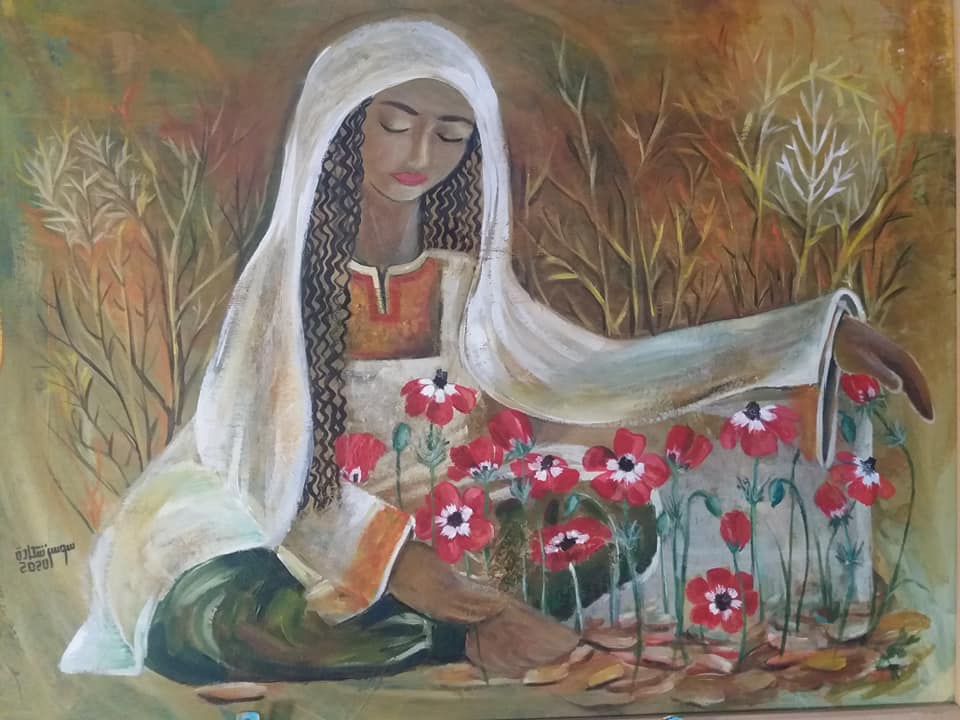
The beautiful featured image is a painting by Sawsan Shashade–it visualizes for me the power of ordinary women who resist despair through finding and nurturing beauty and life.
 A broken tulip
Leave a comment