
We’re handed set answers for what it means to live as a man, live as a woman. We’re told they’re from God but something feels off. So one day we start unraveling these answers. We end up with a pile of loose threads in our hands and one question.
The question was fed by all the small and large things that forced us into the uncomfortable work of unraveling in the first place. It’s a question we may end up asking after years, or after days, but it’s almost always there—can I even trust this God? Does He have any idea of the reality I live with? And if He does….and does nothing…how am I supposed to trust Him?
Maybe this is a question for us women, and the root question for men in these conversations is something different. I’d be interested to hear from men what their question is.
A God who presents Himself as male in our Scriptures, whose Tabernacle kept the women at arms length, who orders His church around men and who let His Word be shaped by the male imagination for eternity can sometimes feel remote and distant from the reality of life as a woman.
Who are you, God? Do you care about me? About us?
A God who asks women to submit in the context of suffering (1 Peter) without acknowledging the depth of that suffering seems hard to trust. His own best men—Judah, David, Abraham—were not men I would trust as a woman, based on their life stories.
Why do women since Eden carry in their bodies not only the promise of redemption but the curses? The ground is cursed when God speaks to Adam, and Adam’s toil will be sweat and unending. He will be yoked in slavery to the land. Fine. Hard work. But the woman’s body will be her hard labour, and the woman’s relationship to the man will be the yoke of slavery to her. Her body. Her home. The serpent himself will war with her throughout time—the woman and the snake, locked into struggle, until she bears the Redeemer.
Doesn’t that seem a little harsh?
Again, I don’t know what it is like for men, but I know that women cannot distance themselves from the effects of the Fall on all life. Especially on what is nearest to us, especially on ourselves. As God points out, the Fall works into our lives in the dominance we allow men to hold over us because of our desire for them, and the pain of bringing new life to the world.
What are we, walking showcases of the Fall? The relational version of thorns and thistles?
I think this is why it is so hard to answer the question under all our questions when it comes to talking about men&women. We know, not abstractly but by experience, that however wonderful God’s idea about men and women was, it’s not reality.
So will God face our reality?
Or does He sweep it away in His own talk, like many women have experienced men in leadership do? Does God listen to us? Not to the pretty talk, but to the reality of how deep the desire is in women, how deep the fear is, how deep the anger bred of helplessness? Does He listen to the depths of our grief over all that is lost? Because collectively, we have lost a lot.
This is the crucial question. It took me quite a few years of studying texts, the Greek alphabet, and thick volumes to acknowledge that what I really wanted answered was this one question about God.
Don’t take as long as I did. Go to the centre. Get God to meet you here—even if you plead like the widow in Jesus’ parable and cling to Him like Jacob did. Only when He blesses you here, can you build out again.
The last time I re-read the book of Lamentations it shook me to the core. In Lamentations the world is turned upside down. The city-woman has the dominant voice and she claims that God has handed her into rape. And yet that fact—that God has let her be violated and shamed—is not her lament. Her lament is that her children, her children, her children, her children! Murdered. That is her bitter, uncomforted lament.
The strongman is the one who protects widow and children yet he is equally helpless in the book of Lamentations. And God, God is charged with having done it all. By the city-woman, by the strongman, by the narrator who becomes a witness.
And God
is
silent.
And this silence, as Kathleen Norris points out, gives the city-woman space to fully grieve, to bitterly lament. God does not use His divine authority to silence the weak and hurting—instead He remains silent and lets us load Him with charges, false or true, who knows in the midst of trauma? But we turn to Him because He is powerful and He is our protector and we have been made desolate by God, shattered by Him, made to drink poison and crunch down on gravel which this God has force-fed us—so says the city-woman.
And then she says, but the mercies of God have not run out. They are new every morning. So we hope. We quote that and ignore that right after those words the book spirals down into further darkness, eventually trickling off in weariness.
God stays silent. He doesn’t speak at the end of the book like He does for Job. He doesn’t take away the discomfort of Lamentations, which means that He doesn’t diminish the validity of the city-woman’s pain. He doesn’t allow His prophet to turn away, either. The narrator is forced by the silence of God to set aside his ideas of what the city-woman did wrong and instead to pay attention, to bear witness, to enter her suffering, and to acknowledge that it is too much pain.
Women, don’t be afraid to bring to God all that is in your heart. Men, don’t be afraid to bear witness. God is with us, on the mourner’s bench, silent.
This week, I will share some of the poems I wrote from this place of anger and grief. Before pretending to understand the hope of God, let us be honest with ourselves about the grief.
Do you trust God to listen to you, a woman?
If you don’t, nothing else will make sense.
So we will start here, with mercies that are new every morning and mouths full of gravel. Tearing our clothes and our hearts with the city-woman. This is the only path towards hope.
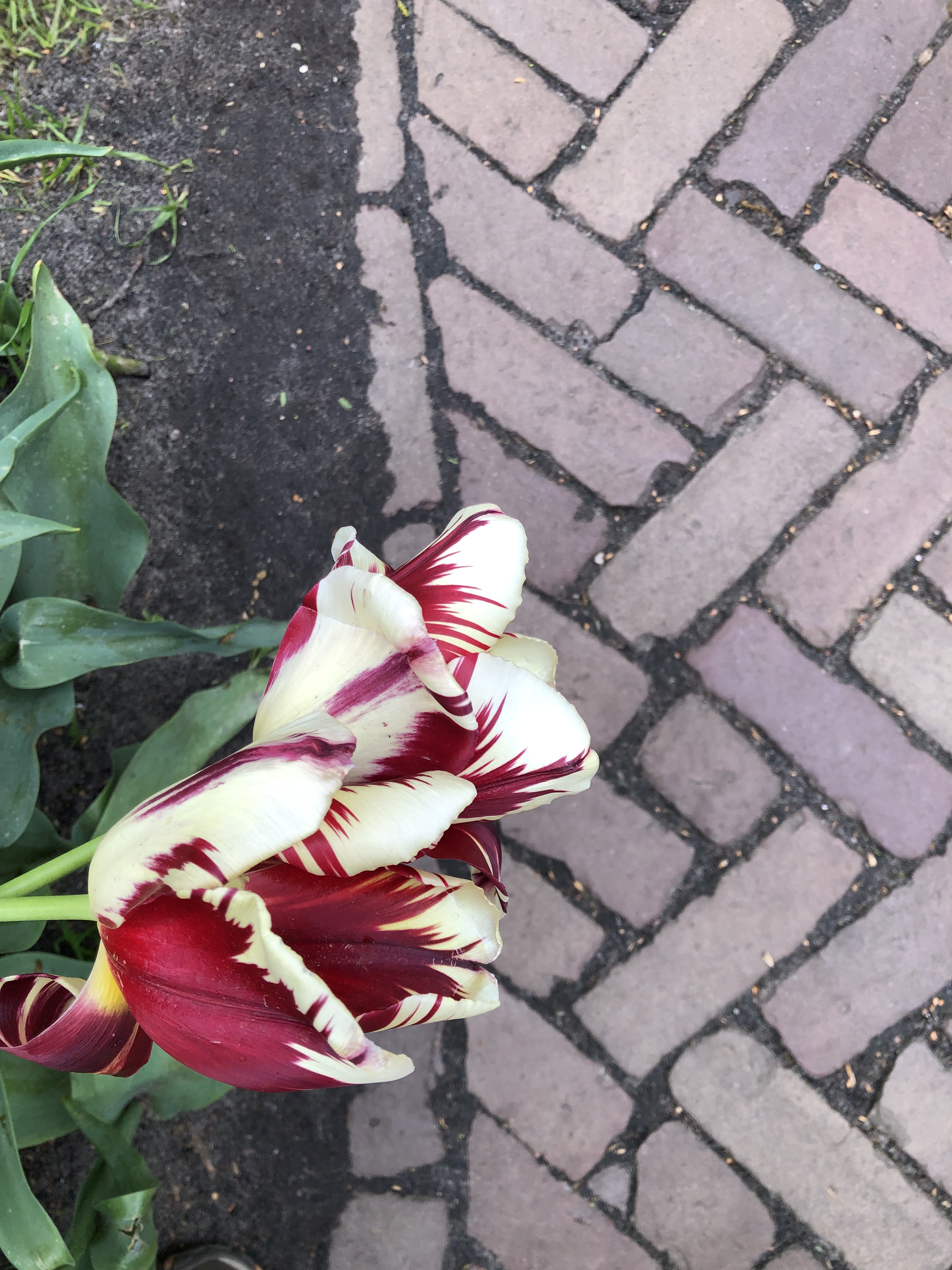
Image by Syarafina Yusof, Singapore, with the title, “God has left us.”


 A broken tulip
Leave a comment