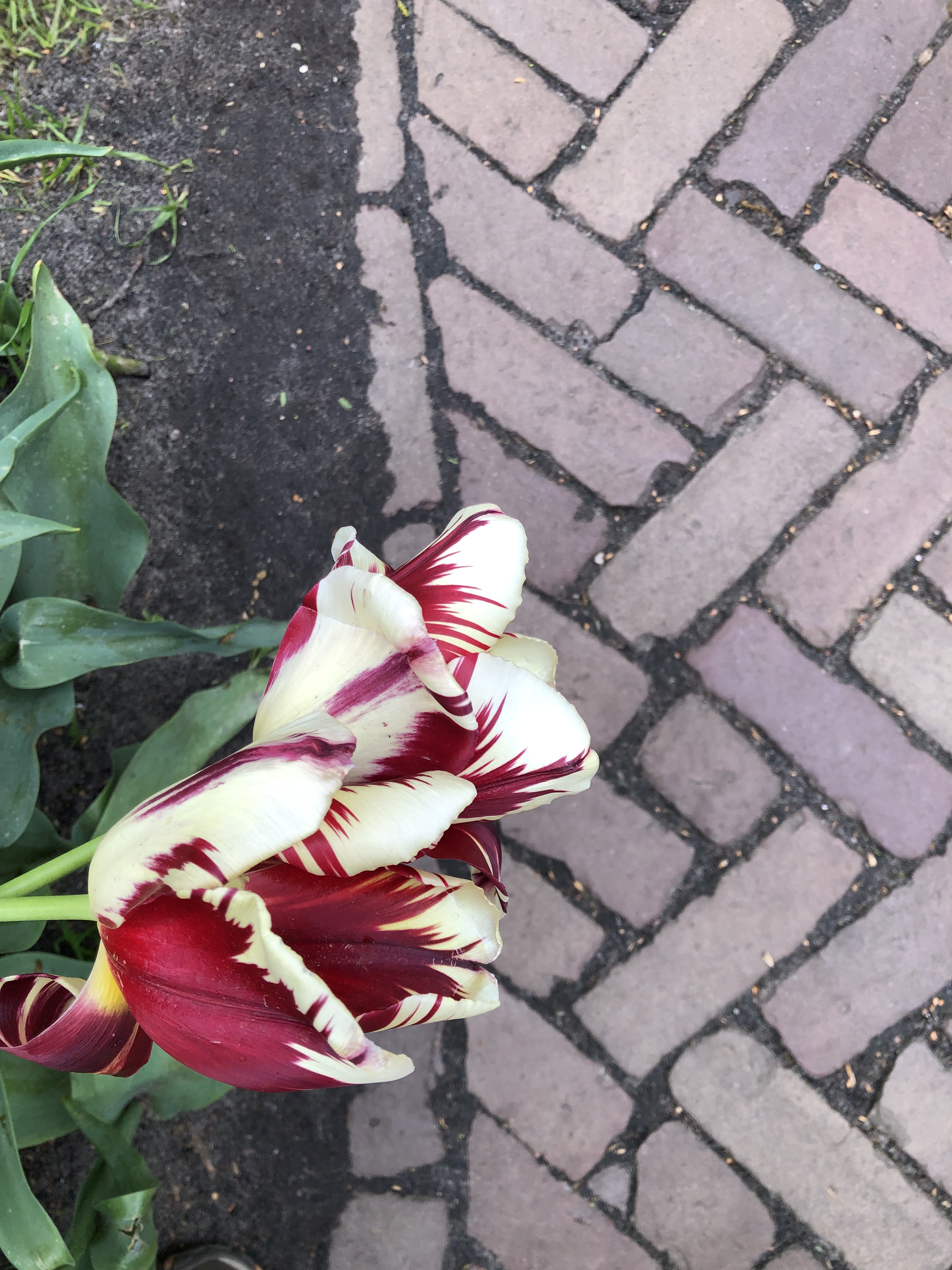
Is there a word expressing that feeling, the moment you touch a wet brush to a pile of dried paint–that infinitesimal fraction of time where you realize liquid potential has seized up into immovable mounds of colour?
My imperfect mural of Van Gogh’s almond blossoms is complete. It took a week of layering colour over colour over colour–and on the the last day, it was pure magic to lean into a closet filled with acrylic smells, smearing on yet another bright, fresh-mixed, never-before-seen colour, leaning with my free hand against the dried paint already built. There’s something magical about coaxing form from a few tubes of primary colours. However imperfect the execution.
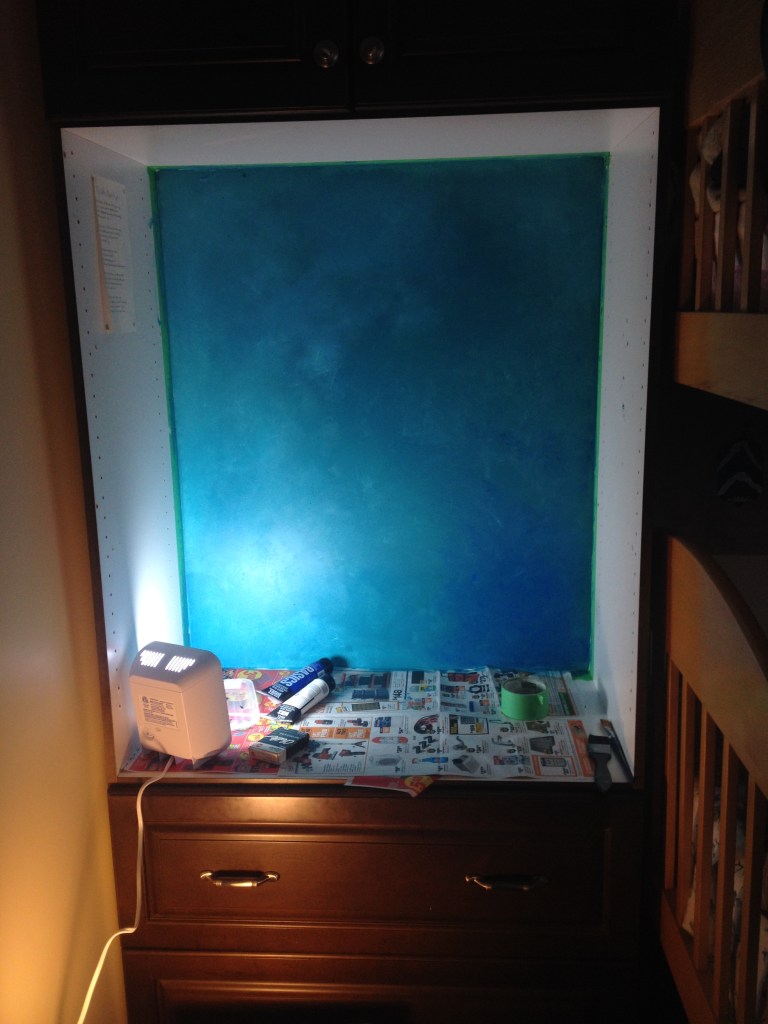
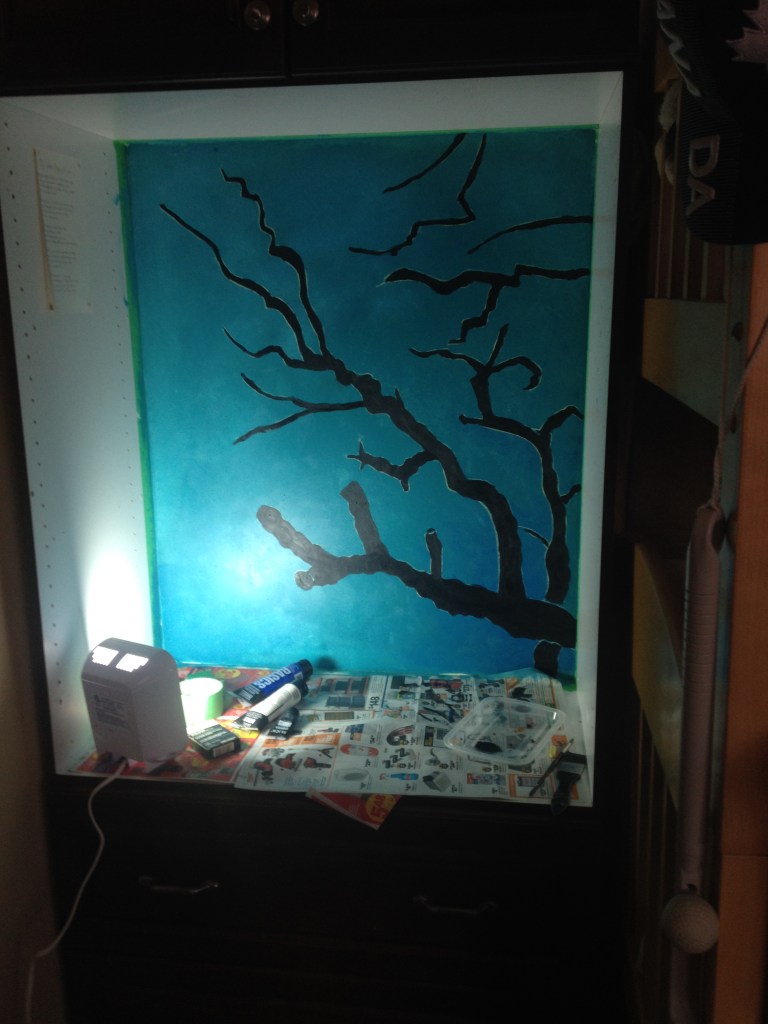


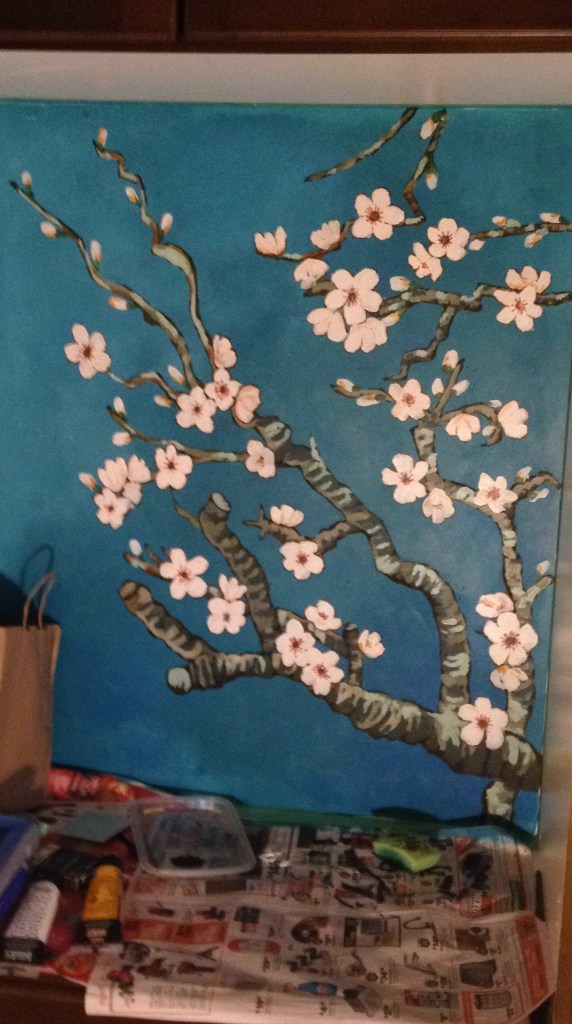
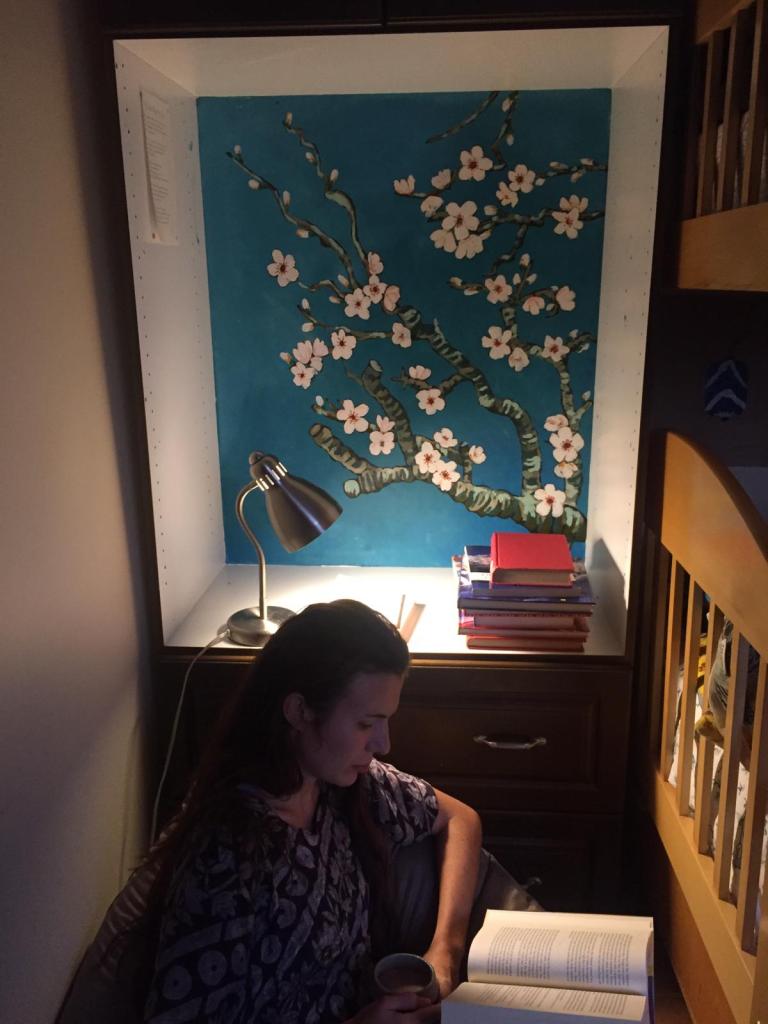
These days, I’m reading What I Talk About When I Talk About Running: a memoir by Haruki Murakami. He compares his long-distance training to run marathons to his work as a novelist. Writing teaches him to run; running teaches him to write. In a sense, that is why I mess with paints: learning a new discipline awakens new associations, new muscles, new consideration of colour, and you better believe that bleeds into writing. It’s odd to pursue things so apparently dissimilar, yet it works. Perhaps it’s because patience comes in many forms — and working in other domains teaches you a new kind of patience. And though I hate to admit it, patience is essential to creating anything.
Here’s Murakami:
“In every interview I’m asked what’s the most important quality a novelist has to have. It’s pretty obvious: talent…. The problem with talent, though, is that in most cases the person involved can’t control its amount or quality…Talent has a mind of its own and wells up when it wants to, and once it dries up, that’s it.
If I’m asked what the next most important quality is for a novelist, that’s easy too: focus — the ability to concentrate all your limited talents on whatever’s critical at the moment. Without that you can’t accomplish anything of value, while, if you can focus effectively, you’ll be able to compensate for an erratic talent or even a shortage of it…
After focus, the next most important thing for a novelist is, hands down, endurance….What’s needed for a writer of fiction–at least one who hopes to write a novel–is the energy to focus every day for half a year, or a year, two years…
Fortunately, these two disciplines–focus and endurance–are different from talent, since they can be acquired and sharpened through training. You’ll naturally learn both concentration and endurance when you sit down every day at your desk and train yourself to focus on one point. This is a lot like the training of muscles I wrote of a moment ago. You have to continually transmit the object of your focus to your entire body, and make sure it thoroughly assimilates the information necessary for you to write every single day and concentrate on the work at hand. And gradually you’ll expand the limits of what you’re able to do….Patience is a must in this process, but I guarantee the results will come.”
As I pushed around the almond blossoms paint, thoughts about Van Gogh ran through my mind. He painted these blossoms for the son of his brother Theo — his nephew, named after him. Vincent. It was close to the end of Van Gogh’s life, in the midst of a flurry of artistic production. He had an epilepsy attack in the middle of making it. It took him almost three months to recover and continue painting.
I’m the nerd with a thick tone on the shelf, a publication of all Van Gogh’s letters. I look up the almond blossoms ones: “Work was going well—you’ll see that the last canvas of branches in blossom was perhaps the best and most patiently worked one I’d done, painted calmly and with greater certainty of touch. Then the next day I was completely wiped out. It’s difficult to understand things like that, but that, alas, is how things are” (April 1890).
He wrote that he would have done more blossoms, if he had the strength: “I really have no luck.”
I think about Van Gogh appreciating his own patient bough of almond blossoms, about setbacks, about how almonds blossomed out of Aaron’s staff as the people of Israel murmured complaints, about how I’ve never seen an almond tree in bloom and yet how we humans can be moved by someone else’s art on a theme we’ve never seen.
I think about the incredible amount of paintings Van Gogh turned out right before taking his life. As if he knew time was limited. How his colours grew so bold, stripping the world he saw down to contrast and texture and movement.
And how sometimes faith looks like Aaron leading, like Van Gogh painting, like you or I writing… to push back the silence. Not, we hope, out of panic, not out of insecurity, but out of curiosity …. and patience.
Thanks for reading today. What artistic pursuits are you up to? How are you pursuing discipline and learning patience? Leave a comment or shoot me an email: abrokentulipinbox@gmail.com
 A broken tulip
Leave a comment