Do you have only one minute today?
Then read these beautiful lines by Czeslaw Milosz:
Here it is still dark. Fog like a river flood
Swaddles the black clumps of billberries.
But the dawn on bright stilts wades in from the shore
And the ball of the sun, ringing, rolls.
Can you see it? The dawn wading in on bright stilts from the shore, in a fog-swaddled world?
I tried to imagine it.
If you have more time today, let me tell you the context of those words. They come in Milosz’ poem ‘The World’, written in Warsaw, 1943. The whole poem is written in simple, childlike language. It moves from the every day sights of his childhood, to faith, hope and love, to fear and recovery and then the sun.
Milosz was born in Lithuania in 1911. He lived through both the World Wars and worked with the Polish resistance movement in Poland in WWII. Later, he lived in America and France. He was awarded the Nobel Prize in Literature in 1980, and died in 2004.
In 2001, in Krakow, he wrote about the challenge to bear witness to the horrors of his time without turning a reporter. He wanted to “acquire the perspective that lets us contemplate the things of this world without delusions. I wouldn’t be exaggerating if I said that, for me, such contemplation acquired a religious dimension.”
His poem ‘The World’ moves in sections. Here is a stanza from the section Fear:
“Where are you, Father? The night has no end.
From now on darkness will last forever.
The travelers are homeless, they will die of hunger,
Our bread is bitter and hard as stone.”
and here is our stanza in the next section, Recovery:
Here it is still dark. Fog like a river flood
Swaddles the black clumps of billberries.
But the dawn on bright stilts wades in from the shore
And the ball of the sun, ringing, rolls.
and the following, and final section The Sun:
All colors come from the sun. And it does not have
Any particular color, for it represents them all.
And the whole Earth is like a poem
While the sun above represents the artist.
Whoever wants to paint the variegated world
Let him never look straight up at the sun
Or he will lose the memory of things he has seen.
Only burning tears will stay in his eyes.
Let him kneel down, lower his face to the grass,
And look at light reflected by the ground.
There he will find everything we have lost:
The stars and the roses, the dusks and the dawns.
Maybe those last stanzas speak to his task, as a poet. To find in reflected light all the things that had been lost in his age. Go ahead, read the whole poem. Let Milosz open your eyes.
I found his poem in the book “Selected and Last Poems 1931-2004” by Czeslaw Milosz.
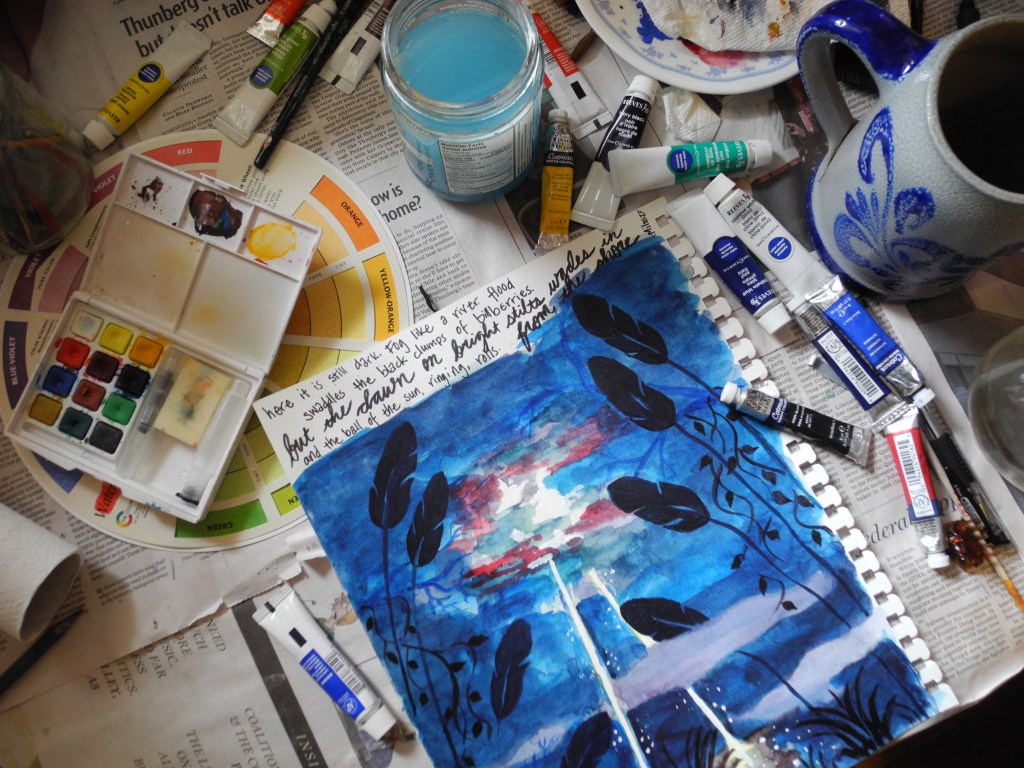
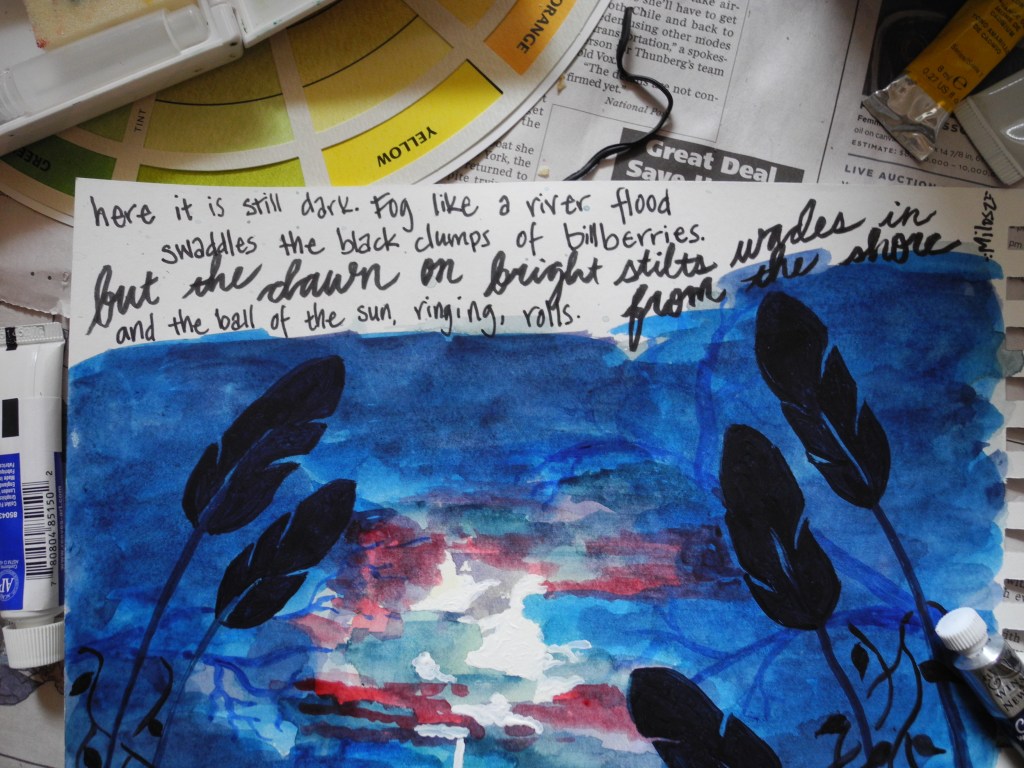
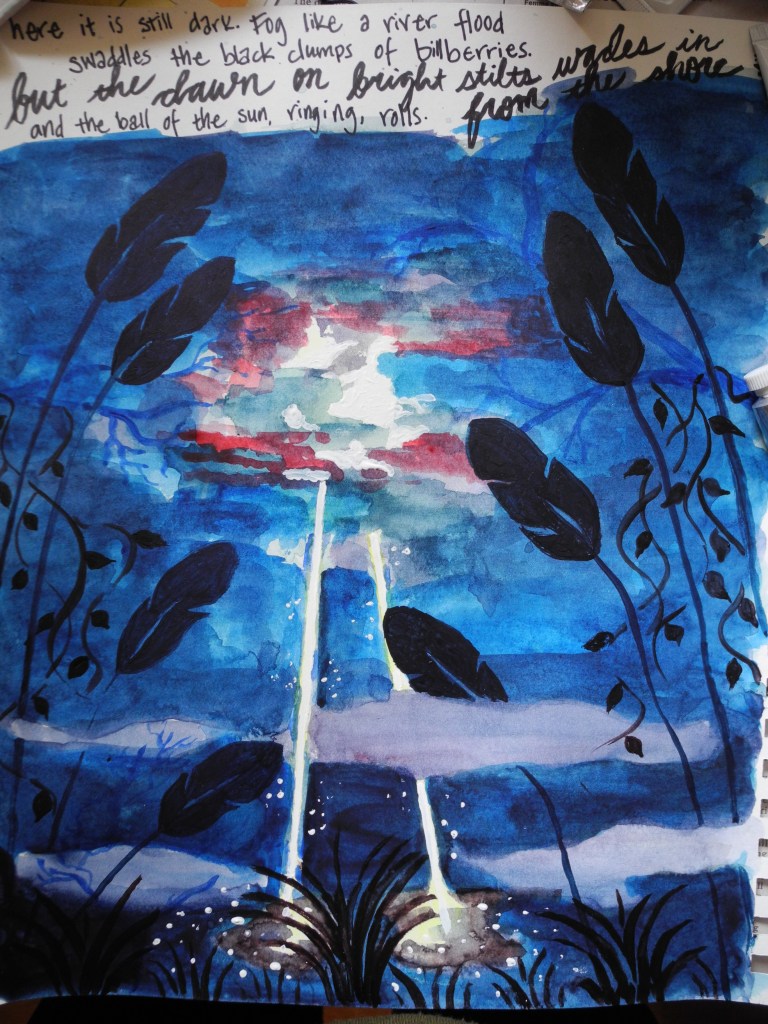
And let it play with your imagination. I started painting without knowing where it would take me… and yes, I know that it is by no means a perfect painting. That’s not the point. 😉 I don’t know billberries, so I painted the tropical plants I know well and was surprised at how my leaves look like feathers. At the last minute I added spots of light around the stilts and they became stars, turning the ground into the sky; or bubbles, rising up from the stilts as the dawn wades through deep water.
What do you see in his words?
 A broken tulip
Leave a comment