
Today, Mr. Singh’s brother tells me India is good.
He has even less English than Mr. Singh, and our conversation stumbles along. We’re in one of the later varieties of strawberries. They’re a dark purple. I don’t like the texture.
“Every night, Pakistan, India, pray. Same time. Every night.” He repeats this, and I think, of all the things he could have told me about India, this is what he chooses… It fascinates me, the image of the Punjab province of India praying at the same time as Pakistan Punjabis. Borders mean nothing to prayer, to history, to blood. The only Punjabi word I have learned from the Singh family is gurudwara, house of God.
“Golden Palace, very nice.” He can’t believe I haven’t been to India yet. “But politicians, no good. No work!” I tell him Canadian politicians aren’t much good either, but he doesn’t believe me.
He says he is going back to India to relax. There is too much hard work in Canada. In India, he can sew clothes and rest.
“Bus driver, store, Brampton. Punjabi speak. Canadian! Punjabi speak.” I just heard about this bus driver being interviewed on the CBC. He has learned to speak Punjabi, the majority group along his routes. They love him for it.
We finish picking. I offer him almonds. He declines. We both collect our pay and he comes over to my car.
He hesitates.
“You, very good.”
Through the open window, he gives me a fist bump. I say, “blessings,” but it is not in his vocabulary. “You, good.” I say, “You, good life.” He smiles.
What stories will he bring back to India, to restful, praying India? About a Punjabi-speaking bus driver? About the hard work it is to pick strawberries, to move boxes all day in a chip factory? About a girl who has never seen the Golden Palace?
I watch him shake out a large handkerchief, checkered red-white. He waves at me to join him and eat. I clasp my hands in gratitude, and decline.
Why do tears come as I drive away?
A few days earlier, on my way home from the strawberry fields, I passed a woman in a hijab pushing a baby stroller. There was no sidewalk and she struggled to push it over the mowed grass along the road. I wanted to stop, to offer help – but I didn’t. Torn between my own feelings as a pedestrian when it is assumed that I need help, and my assumption that she could use a kind word even if she turns down the helping hand, I waited too long. The light turned green and I moved forward. I kept checking in my mirrors for one more glimpse of her.
Yesterday I saw a broken bird. Only one wing left intact, the rest of the body squished into dark pavement. That one, crooked wing, like a flag. My stomach lurched as the car drove over it. What is it about today that reminds me of that bird?
We miss our chance to witness the hard things, the broken things, because we are afraid of them.
Today, Mr. E, one of the Mexicans, demonstrated a faster way to pick. As he walked away I said, “Gracias.” He stopped, stood very still, and turned around.
Now the tears come. I have been a stranger too. I have stumbled through a foreign language, sweating hard to put nouns and verbs together to make the most basic observation or question. I have experienced the infinite kindness on the other side of these slow conversations. In one word, I have heard from the lips of a stranger, the sound of home.
How can simple language offer so much kindness? But it does. It does.
Image by: Joyce K. Jensen
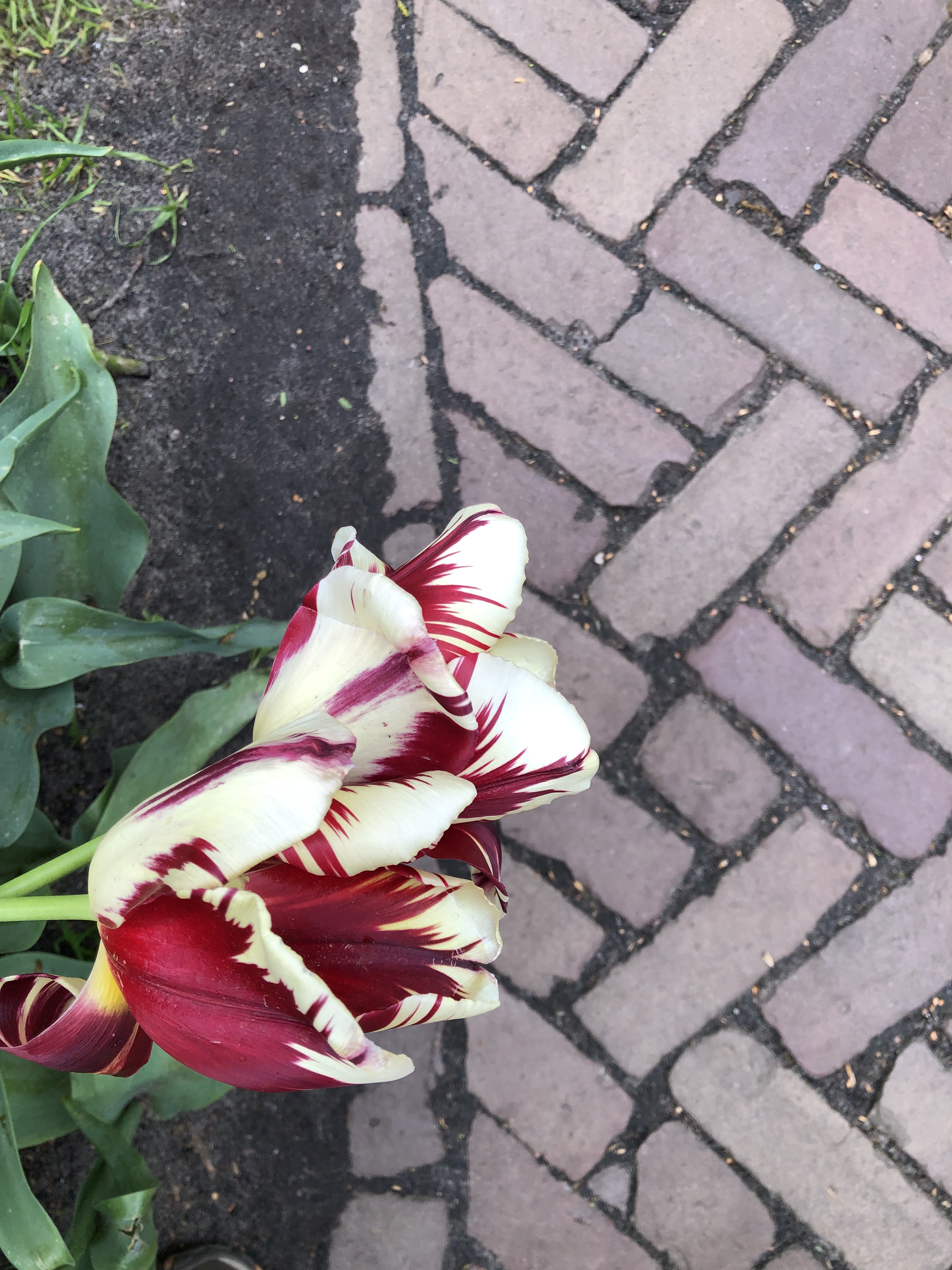
 A broken tulip
Leave a comment