Plumbing the depths to the place in between
The tangible world and the land of a dreams
Because everything ain’t quite it seems
There’s more beneath the appearance of things
A beggar could be king within the shadows,
Of a wing(Josh Garrels, Beyond the Blue)
“Write only if you cannot live without writing. Write only what you alone can write.” – Elie Wiesel
“Every man who has shown the world the way to beauty, to true culture, has been a rebel, a ‘universal’ without patriotism, without home who has found his people everywhere.” – Potok
Words stream through my mind as steadily as I thrust downward on my bike pedals, as swiftly as the sights and sounds that are gone before they can greet my senses. As I bike I am conscious of words painting everything I see.
Short lads swerve along on their scooters beside me, and girls parade their sparkling bikes. The newly planted plants along the path look as if the soil doesn’t suit them. Self-awareness blushes through the green leaves.
Those grey streaks in that lady’s hair are much more settled. She leans against a curved lamp posts, arms crossed over her stout waist. A Latino man leans, mirror image to her, looking the other way. He is waiting by bottles of Gatorade for someone to stop and make his patience worthwhile. His hair has no grey.
Words. Why do I paint a world to myself when it is already right before my eyes? I don’t know.
All my life, I have had the sense of eyeballs levelled at me like guns. As a child of missionaries, everywhere we went, people watched. I wanted everything I said and did to match their unspoken expectations. I was proving the validity of my parent’s call, of God’s choice of our family, of the decision to homeschool, of moving across an ocean with a family of eight. I understood we were different, and I wanted to justify it.
But that sub-zero gaze on my life, whether real or in my imagination, froze the wells of creativity. Embarrassed, the day came I could not make a sound on my flute for my teacher – all my love for music froze in fingers that could not be perfect. Frustration and fear bred clumsiness and silence. I never labelled myself as a ‘writer’ or a ‘creator’. I never thought of myself as an artist. I didn’t want anyone to see any of my mistakes, ever.
“Is not My Word like fire?” asks the Lord. Living with the fire melts the ice of my heart, and acceptance of process is trickling up and out, like the sweet sap of a maple tree in Spring.
“How blessed is the man whose strength is in You, in whose heart are the highways to Zion! Passing through the valley of Baca they make it a spring; the early rain also covers it with blessings. They go from strength to strength, every one of them appears before God in Zion.” (Ps. 84:5-7)
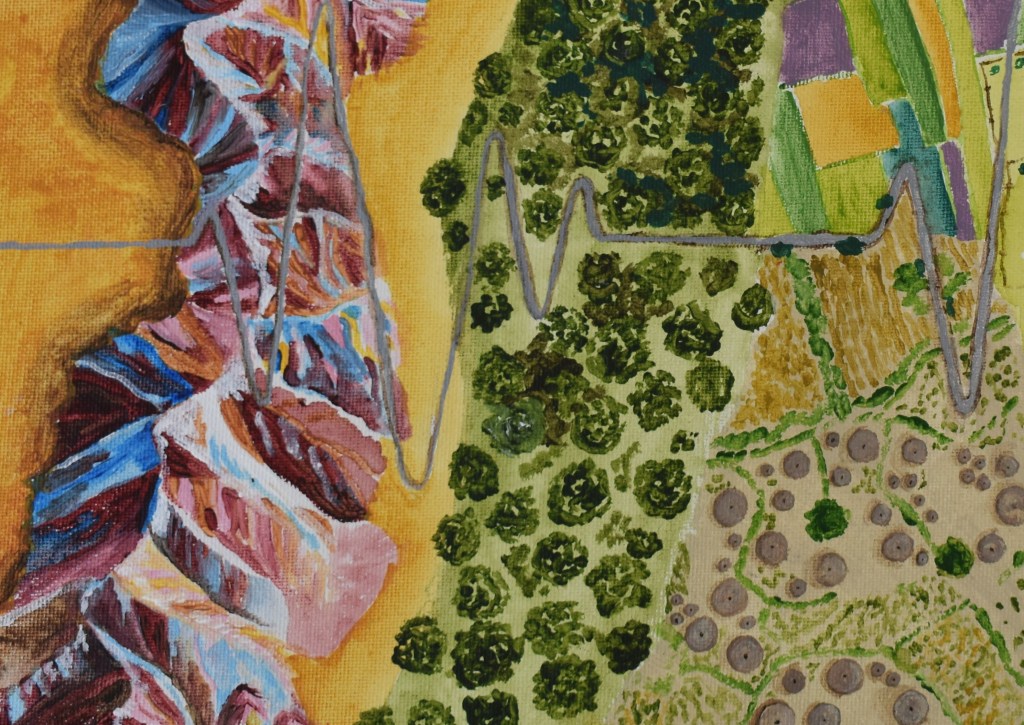
I’ve been shown many models of Christianity. But in Congo, I’ve seen the drawings of forgiveness, of dealing with trauma, of the Christian life, and it’s always circular roads between villages. You go from one to the other, and sometimes you backtrack, lose your way, get lost, and keep coming back and journeying on. My art is a statement that I am between villages, with the hope that as I pass through valleys of weeping, God will make springs and bring His own rain of blessings. The hope that the highways in my heart will bring me to His face and that He will be strength, and will always be enough.
“Therefore Jesus also, that He might sanctify the people through His own blood, suffered outside the gate. So, let us go out to Him outside the camp, bearing His reproach. For here we do not have a lasting city, but we are seeking the city which is to come.”(Hebrews 13:12-14).
Not just is Jesus journeying, He is exiled. He is maligned, misunderstood, mistreated. I stand with Him. I am seeking the city to come.
Kathleen Norris says that it is heresy to tell an artist that they are more creative than other people. God creates; everyone imagines and makes. Artists have imaginations like any plumber or teacher. What sets artists apart is their response to life which puts them into an exile of otherness from society. Those responses also give them their right to speak into community through their creations. Theirs is a unique suffering.
If artists had a patron saint, it would be the unidentified woman in Matthew who pours perfume over Jesus. Matthew pauses between explaining the plot for arresting Jesus and plunging into the betrayal to tell this story: a woman takes her jar — smooth, fine, translucent — and pours it over the head of Jesus. A woman anoints God. There is another story of Mary, who loved Jesus, pouring her sweet-smelling nard over His feet, wiping them with her hair. In both stories, these women are mocked by all around them. But Jesus validates their actions.
Norris sees the artist in this story,
“Maybe monks and poets know, as Jesus did when a friend, in an extravagant, loving gesture, bathed his feet in nard, an expensive, fragrant oil, and wiped them with her hair, that the symbolic act matters; that those who know the exact price of things, as Judas did, often don’t know the true cost or value of anything.”
“Artistic action,” Harold Best says, “is nothing other and nothing less than pouring perfume on Jesus’ feet”
Everywhere, poets and writers and musicians understand that there will always be Judas’s, that as an artist you must live as the other, pouring everything out on the feet of Jesus. This is a commission: “Listen, O daughter: Forget your people and your father’s house; Then the King will desire your beauty.” (Ps. 45)
Potok, in his masterpiece My Name is Asher Lev, describes the agonies of a painter who must put what he feels is true onto canvas, despite what his Rebbe, community, or family says. Not only must he paint, those paintings must be public. The process is not complete otherwise.
Sometimes, I think being an artist is like breathing in winter. Every breath fogs, holds shape, is seen by all around you, whether you will it or not. My soul breathes in crystallized images and words – tremoring forms – and it can be terrifying to let someone else among them.
Reality and hope must meet. The circular roads bring us home: How happy is the one whose strength is in God! They go from strength to strength. Every one of them appears before God in Zion.
If you’re joining in now, you can find my introduction to this Theology of Craft, and the first part, Theology of Creation here.
Image: detail of a painting for a friend, off of the Ps. 84 passage.
((and, you guys — this site is now AD FREE!! I am so excited for them to be GONE! hoping to keep it this way ;))
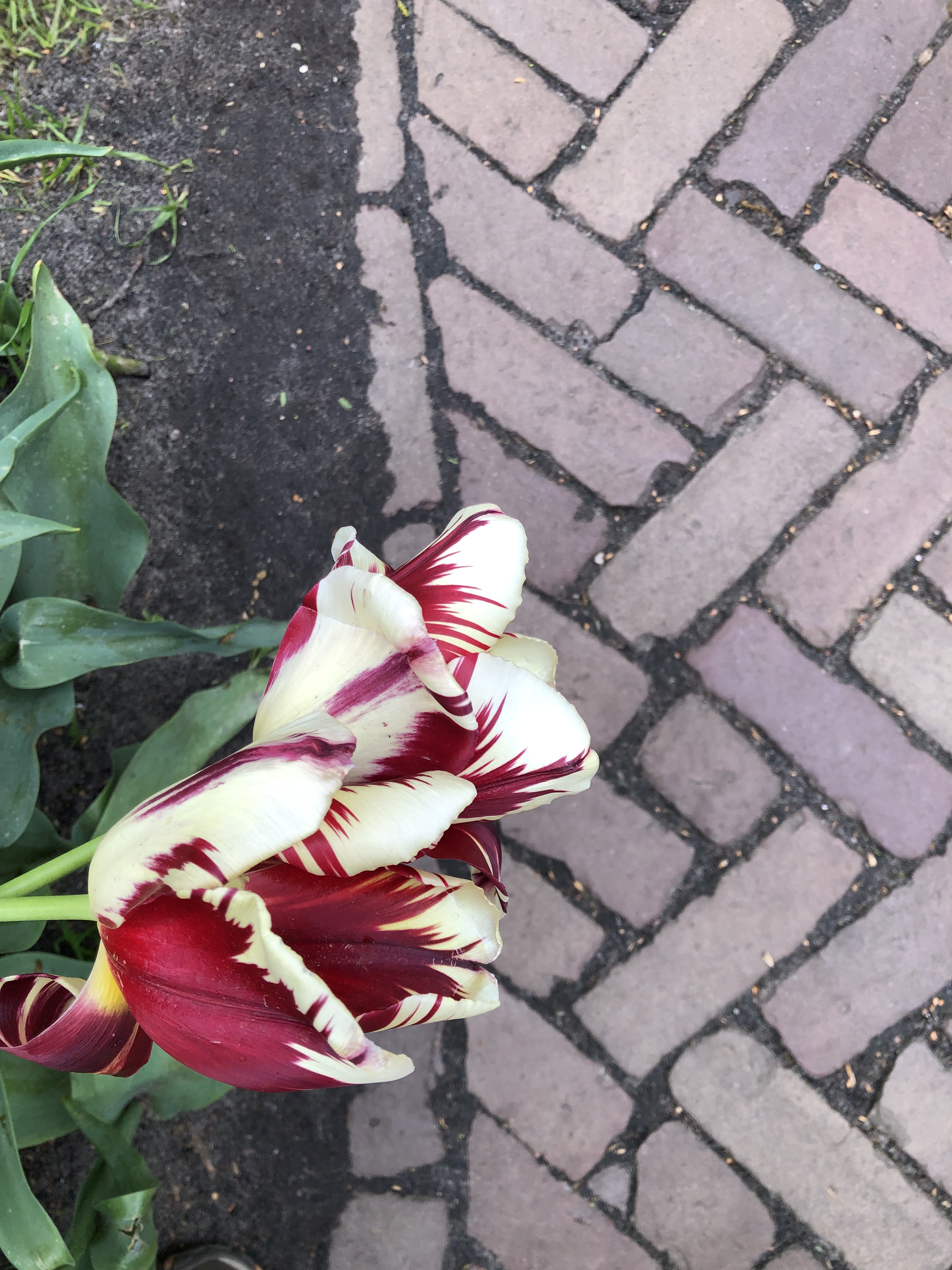
 A broken tulip
Leave a comment